In the world of work, it helps to see the world around you through an economic lens. Put with brutal simplicity: money is the lifeblood of the economy. Healthy countries circulate it; dying countries lose it. But like blood flow in a person, it's hard to tell exactly what's going on with the circulation inside. Complicating this, there are political actors in your economy and mine who depend on either good or bad economic news, and often exaggerate the indicators to enhance their cause. So you can't just trust the top headlines to see how your country's lifeblood — its money and economy — is flowing.
I'm writing a series of Economic Lens articles by country, for two purposes. The first is to give you a snapshot of how your country is doing. Of course, you know better than I do what life is like on the ground. But my training and experience help me give you a more comprehensive picture as it relates to employment and work. The second reason: I want to show you how to look at an economy, for the purpose of giving you a competitive edge in finding and succeeding at work.
I've been to Kenya many times. Some of the scenery is breathtaking. There is a magic, resilient, and irrepressible energy among the people. There are challenges — some I can see, and others that create suffering I cannot fathom. But I have met hundreds of people all over this country, and they're going to be the reason it continues to grow in size and influence.
Economic Overview
Kenya's economy is growing faster than expected — 5.3% in Q1 2026, its fastest first-quarter growth since 2023 — while inflation is quietly re-accelerating (6.6% in August) and debt service eats something like half of government revenue. That puts pressure to keep taxes high, and because Kenya has such a large informal economy, the government must find that tax revenue in consumption — taxes on ordinary things people buy.
Over 80% of new jobs created in 2025 were informal, which makes unemployment figures difficult to report accurately.
The Q1 growth was led by tourism — accommodation and food services grew 14.7%. A rippling global energy shock points to risk in those sectors going forward. Inflation is the number to watch: it hit 6.6% in August 2026, its second straight monthly acceleration, driven by transport costs (+15.7%, partly Middle East shipping disruption) and food (+9.0%). Inflation makes it harder for businesses to balance profitability without raising prices so much that demand drops.
Industry and Sources of Employment
Kenya's economy has a split personality: the sector that employs the most people is not the sector that produces the most output. Agriculture is the largest contributor to GDP at 23.2%, but growth slowed sharply to 3.1% in 2025 (from 4.4%) after an unexpected 2026 drought devastated the western maize basket. Coffee is a bright spot, rebounding 13.3% to 850,000 bags, and Kenya remains the world's leading rose exporter to the EU. Tea volumes rose, but revenue fell 1% on weaker prices. Agriculture is one of those industries — worldwide — that desperately needs more technology applied to it, so consider that an entrepreneurial opportunity.
The informal sector — 18.1 million workers, over 80% of total employment — dwarfs formal wage work (3.3 million). Within informal work, wholesale and retail trade alone accounts for 10.7 million jobs, more than half of all informal employment. For perspective: manufacturing employs 388,564 people, and public administration 375,100. It seems cool and resilient to have such a big informal economy. But it's a problem for the government, because tax collection is harder. And informal economies are hard to build and scale to the point where they could become much bigger — collectively — in revenue and employment than the individual pieces are separately.
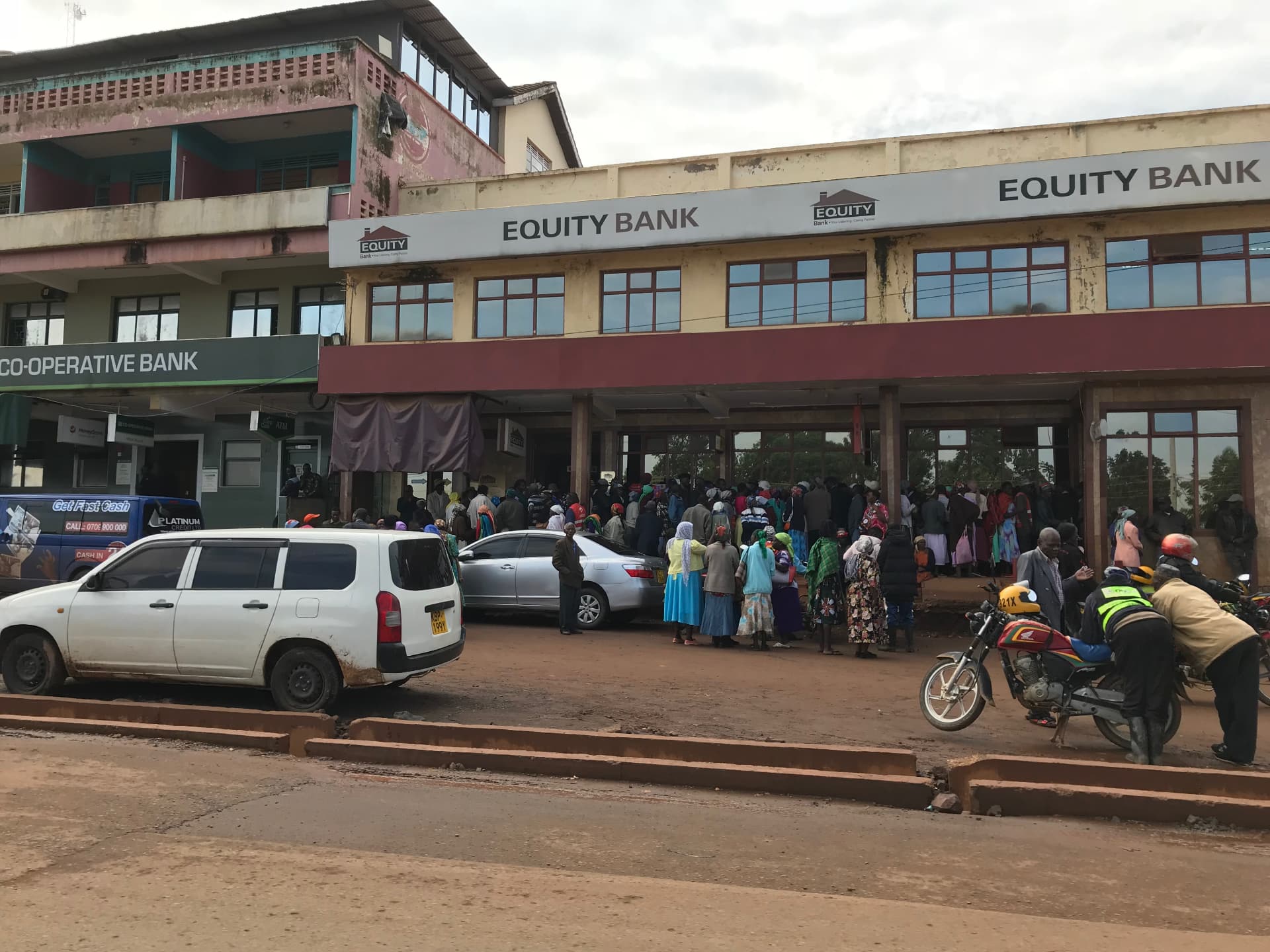
Tourism had its best year on record — 7.9 million visitors in 2025, KES 500 billion in revenue, up 10% for a fifth straight year — yet Kenya Airways lost KES 17.2 billion the same year, and widened that loss further in H1 2026 on rising fuel costs. The sector booms; the flag carrier doesn't. Banking is quietly Kenya's strongest performer — KCB's profit rose 21% and Equity Group's 32% in H1 2026. Yet the very high debt in Kenya makes it harder for banks to lend money to businesses that can and should grow. Still, having profitable banks is a good economic sign. When your uncle tells you they're just getting rich and making the rich richer, you can say, “You're right” — and then tell the rest of the story: “Money goes where it can grow, so it tends not to stay in rich people's hands very long if they see an opportunity for growth by investing or spending, both of which benefit the rest of us.”
What About Technology?
Kenya's mobile money system remains one of the most consequential pieces of financial infrastructure on the continent — but its dominant platform is losing ground. M-Pesa's share of the mobile money market has slipped for six straight quarters, down to around 89% from a historical high near 98%, as Airtel Money gains. Even so, Safaricom's M-Pesa revenue grew 13.4% to KES 182.7 billion in the fiscal year to March 2026 — now 45.6% of its Kenyan revenue — processing nearly 47 billion transactions worth KES 41.68 trillion. Fuliza, the overdraft built on top of M-Pesa, disbursed KES 1.47 trillion to 17.7 million users over the same period; 58% of Kenyans report having used a digital loan app to cover an emergency. This is a country whose financial life runs on a phone.
A widely cited survey found 97.5% of Kenyan internet users had used “an AI tool” in the past month — ranking Kenya #1 globally, ahead of the US and UK (from a TechTrends Kenya report) — but that almost certainly captures casual use of AI features baked into Google or WhatsApp, not deep integration. A more sober enterprise survey found only 35% of Kenyan organizations at “advanced” AI implementation, despite 96% saying they'd “started a journey.”
Elsewhere: ride-hailing and gig platforms support roughly 1.5 million workers generating over KES 130 billion a year, and a new Competition (Amendment) Bill would let regulators set minimum fares after years of driver disputes with Uber and Bolt over falling commissions. Nairobi's tech sector had a rough stretch — Copia Global's collapse and KOKO Networks' complete shutdown in January 2026 together account for 43% of all disclosed tech job losses across Africa since 2023.
The 12-month outlook is cautious (4.3–4.9% growth) and, more concretely, on the government's own admission: Ruto has said Kenya's economy can absorb only about 200,000 of the roughly one million young people entering the labor market each year. I'm not a math major, but that's a big problem. Kenya needs to draw international investment and businesses to help offset those numbers.
Reality on the Ground
Two surveys of young Kenyans taken within months of each other disagree sharply, and that disagreement is itself informative. The African Youth Survey 2026 found Kenyan youth the least optimistic about jobs and the economy of any of 16 African countries surveyed — 80% say the country is moving in the wrong direction. Afrobarometer's 2024/25 round found 61% of youth think things will get better in the coming year, even as 43% say they're actively job-hunting, nearly double the rate among older Kenyans. Both can be true: a generation that hasn't given up on the country while it has largely given up on finding formal work in it.
The clearest evidence of that gap is where people are going instead. TVET enrollment has more than doubled since 2022, reaching 825,484 trainees in 2025 — a genuine, large-scale bet on vocational skills over a university degree that may not lead anywhere. At the same time, an estimated 400,000-plus Kenyans now work in the Gulf, Saudi Arabia the single largest destination. Amnesty International's May 2025 report on Kenyan domestic workers there documented what it called conditions amounting to modern slavery — contracts substituted on arrival, passports withheld, wages unpaid for months.
Germany's 2024 bilateral labor deal, floated as a pathway for up to 250,000 skilled workers, has produced 495 actual job orders so far. The UK's nursing pipeline, aimed at 20,000 placements, has moved 280 nurses with 200 more waiting. The gap between the announced scale of these programs and their delivered scale is consistent, and large.
What young Kenyans are doing, absent formal jobs, is stacking side hustles rather than waiting for one to materialize — an accounting graduate driving a cab, an education graduate running a grocery stall. It's not resignation so much as a rational response to a labor market that, by the government's own admission, can only absorb a fifth of the people entering it. Betting is a visible, contested part of that landscape — estimates of youth participation range from 40% to over 80% depending on the survey, and Kenya is reported to have the highest rate of frequent youth gambling in sub-Saharan Africa, with rising cases of gambling-related mental health harm reported at Nairobi's Mathari hospital. And for those still applying formally: a Kenyan graduate reportedly takes years, not months, to land a job; three-quarters say they lack the professional networks that actually get people hired; and job seekers are regularly targeted by scams charging fake “interview fees” to people who can least afford them. We created a tool on our site — Is This Job Real — it's a free scam checker. If you use it and like it, spread the word.
Conclusion
Kenyans have a lot to be proud of, and there is genuinely good news in the economic data. Dangers, yes — but real progress too. I can't wait to visit again.