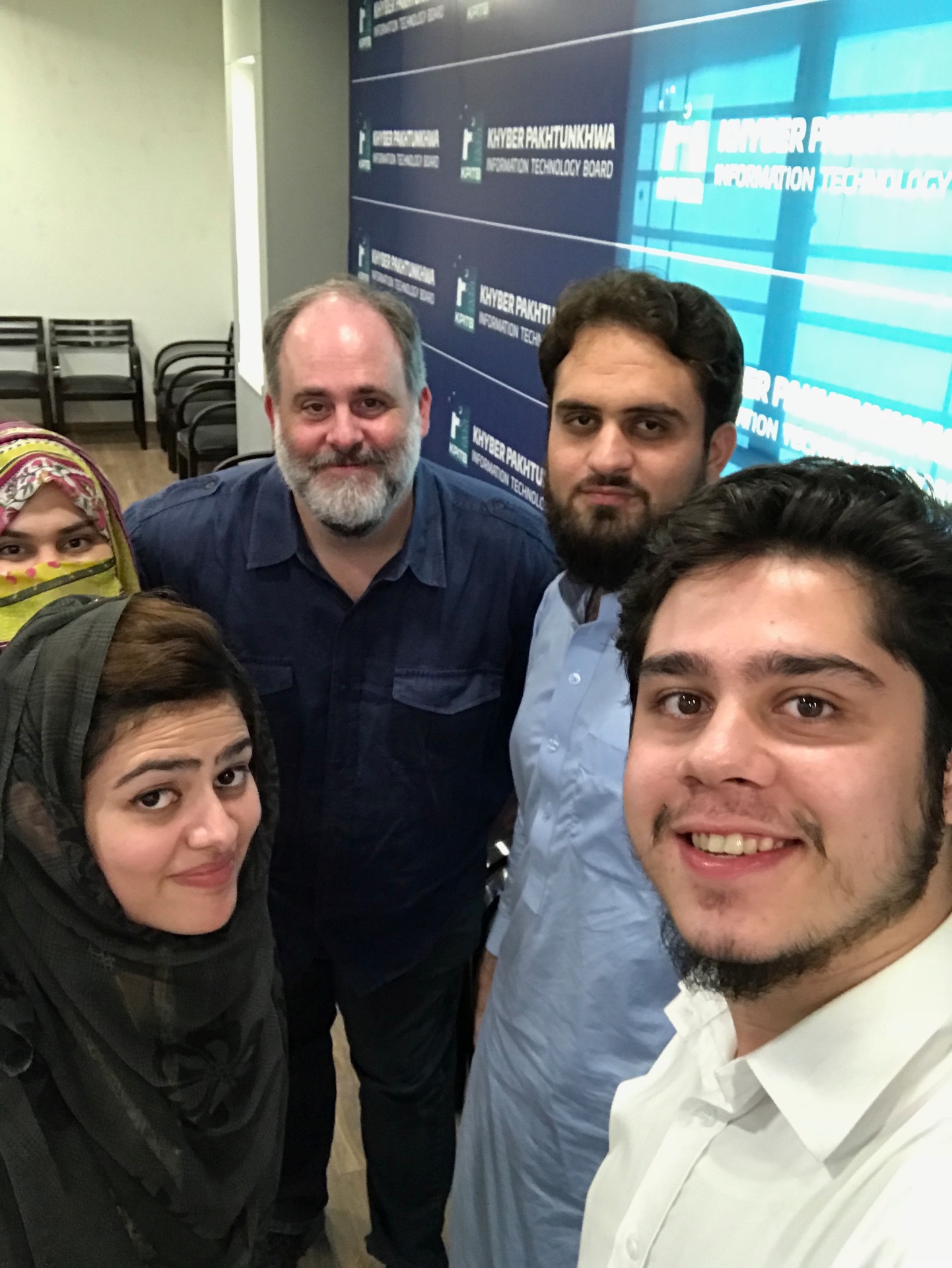
Outside a mobile phone store in Peshawar, Pakistan, I stood with four young people waiting for our driver to bring the vehicle around.
Yes, that Peshawar — the Peshawar in the Federally Administered Tribal Areas of Northern Pakistan. The same general area where Osama Bin Laden was found hiding. It was warm and extraordinarily loud in this bustling part of the city. I had arrived from Islamabad in an armored vehicle with other World Bank staff because of the very real danger posed by hostile militants operating across the porous border with Afghanistan. In 2017 and 2018, that danger was not limited to western visitors like me — it extended to Pakistani military and police fighting an active insurgency in the region.
The four young people standing with me were local. College degrees, strong English skills, and a quiet eagerness to prove themselves. They were participants in a youth employment initiative I was helping to run — a collaboration between the World Bank and the KPITB (Khyber Pakhtunkhwa Information Technology Board) designed to address the region's alarmingly high youth unemployment numbers. My job was to train them so they could train others in digital job skills, which would then be taught in local schools alongside practical vocational programs in furniture making, equipment repair, and similar trades.
We had just purchased internet equipment the schools would need. As we waited, I taught them how to do an exploding fist bump — a gesture that requires timing, just the right amount of theatrical flair, and the subtle but critical sounds that make the whole expression land. There were smiles and laughs, even from the most stoic member of the group. That moment is etched into my memory permanently.
The Scale of the Problem
Those four young people are not exceptional cases. They are representative of tens of millions of young people I have encountered, worked alongside, and thought about across decades of international work. They are bright, capable, eager, and hungry for the chance to put their skills to use. And in too many places, that chance is not coming.
Two numbers establish the scale. In 2024, approximately 13 percent of young people aged 15 to 24 worldwide — roughly 65 million people — were actively looking for work and unable to find it. In the United States, that figure sits at 9.7 percent for youth, compared to an overall unemployment rate of 4.2 percent. Even in the wealthiest, most opportunity-rich country in the world, young people face a significantly harder path to employment than their older counterparts.
The second number is more troubling. Around 20 percent of young people globally are categorized as NEET — Not in Employment, Education, or Training. One in five young people, worldwide, is not working, not studying, and not building skills toward either. These are the young people most at risk of being permanently left behind.
Global averages, however, tell a comfortable story that the underlying data does not support. In 19 countries, youth unemployment exceeds 30 percent. Nearly a third of an entire generation, in those places, cannot find work. Thirteen additional countries carry rates above 25 percent. In many regions within those countries, the numbers are worse still — the averages are pulled down by the relative concentration of jobs in larger cities, while rural youth unemployment runs far higher.
Why This Matters Beyond the Headlines
I understand the instinct to compartmentalize. If you are managing your own credit card bill and healthcare costs and career pressures, the youth unemployment crisis in Pakistan or Kenya or Eastern Europe can feel remote. I am not going to pretend otherwise. But I do want to offer three reasons why this problem has a way of arriving on your doorstep whether you send for it or not.
Talent Flight. A meaningful percentage of the young people I have been describing are highly trained and deeply frustrated. When their home countries cannot provide opportunity, they move toward countries that can. This is not mass migration of the desperate — it is a structured, accelerating flow of developers, engineers, service professionals, and technical specialists relocating to markets where their skills are valued. Talent follows opportunity. It always has. That flow creates competitive pressure in your labor market, regardless of where you sit in it.
Weakened Home Countries. When a country loses its most educated and ambitious young people, it loses far more than workers. It loses tax revenue, consumer spending, innovative capacity, civic participation, and the next generation of government and business leadership. Remittances flow back, but they do not replace the compounding loss of human capital. Countries that cannot hold onto their talent tend to become more unstable over time, and instability has a way of exporting itself.
Unemployed Youth Bulges Are Dangerous. Young people who have done everything right — studied hard, earned credentials, developed real skills — and still cannot find work experience a specific and volatile combination of emotions: fear, anger, and a creeping sense that the system is rigged against them. That combination is not lost on the criminal organizations, radical movements, and ideological groups that actively monitor social media and informal networks for exactly those signals. Recruitment into dark purposes is a documented downstream consequence of large-scale youth unemployment. What starts as a domestic crisis has a way of becoming a global one.
Who Is Actually Doing Something About It
There are organizations and businesses making a genuine difference. I have worked with several of them, and I want to name a few that have earned my respect.
The World Bank. Beyond capturing and publishing the data that makes it possible to understand the problem at scale, the World Bank runs programs and initiatives inside countries that combine funding with technical assistance. The program I was part of in Peshawar was one example. The organization is large and imperfect, as all large organizations are, but the people I worked alongside were serious and committed.
The Rockefeller Foundation. The Foundation's Digital Jobs Africa initiative has created tens of thousands of digital jobs through grants focused on business formation, skills training, and employer matching. Results-oriented work on a real scale.
Save the Children. Their focus on market-relevant vocational training and support for youth-led businesses is particularly valuable in conflict-affected regions — exactly the places where the need is greatest and the institutional capacity to address it is weakest.
The Business Services Industry. This one may surprise you, and I want to be direct about it. The outsourcing industry — now more commonly called Business Services, IT Services, or Managed Service Providers — is one of the largest employers of young people in developing economies, and it is largely invisible in conversations about global youth unemployment. These are the companies that Fortune 500 firms, banks, insurers, and technology companies pay to perform everything from AI training and cloud services to medical transcription and data conversion. I spent years as a business leader finding and developing a global network of these providers. That work is how I met so many of the young people I am describing in this article.
The largest players — Accenture, Tata, Cognizant, IBM, Infosys — have substantial operations across dozens of developing countries, employing hundreds of thousands of people in roles that carry real career trajectories, not dead ends. Smaller specialized firms operate in specific niches. The mental image of exploitative conditions exists because those conditions do exist in some places — I have seen them. But there is a vast parallel world of businesses that invest seriously in infrastructure, training, and leadership development for their people. That world deserves more credit than it receives.
One organization I want to call out specifically is Digital Divide Data, which partners with technology companies to conduct AI training work in Kenya and other developing nations. What distinguishes DDD is that their model is built around recruiting the most vulnerable people in those communities — not the easiest candidates — and giving them the training and opportunity to advance. Visit their site. It is some of the best work being done at the intersection of technology and human development.
A Note on Tariffs and Outsourcing
The recent tariff debates have pushed offshore business services back into public conversation, usually framed as jobs being stolen. I want to offer a more accurate frame. Lower cost is a factor. But the primary reason companies source services from the Philippines, Vietnam, Kenya, or Eastern Europe is because that is where the expertise lives. The talent pools in those regions, for specific technical and service capabilities, are genuinely exceptional. That is not a politically convenient thing to say, but it is true.
Closing
Debi Hamill, CEO of IAOP — the professional association for the outsourcing and business services industry — told me years ago that I should write an article on this subject. For years, she has used her platform to spotlight the organizations and individuals who are making a real difference in the global youth unemployment crisis. Her persistence and clarity of purpose inspired me, among many others, to raise my own voice on the issue. This article is one small way I am following her example.
The four young people outside that phone store in Peshawar were not a charity case. They were not a statistic. They were professionals in training, doing serious work in a dangerous city, and taking a moment to laugh about an exploding fist bump with an American who showed up to help. That moment represents something real about what is possible when serious organizations and serious people decide to do something about a problem most people have already scrolled past.
They deserve better odds than the world is giving them. So do the 65 million others.