Agamemnon has a bad reputation.
Sure, there is the whole 'sacrifice his daughter' thing, which I suppose can put someone in a bad light. I'm hoping to see some Agamemnon Halloween costumes this year but right now, there are no children dreaming of growing up to be like him. He's an obscure figure known mostly to the bookstore faithful who have read Homer. Agamemnon's reputation took a big hit when he was played as a surly, badly dressed supporting villain in Brad Pitt's Troy — a film that was always going to portray him in the worst possible light, given that it existed primarily to make Achilles look magnificent.
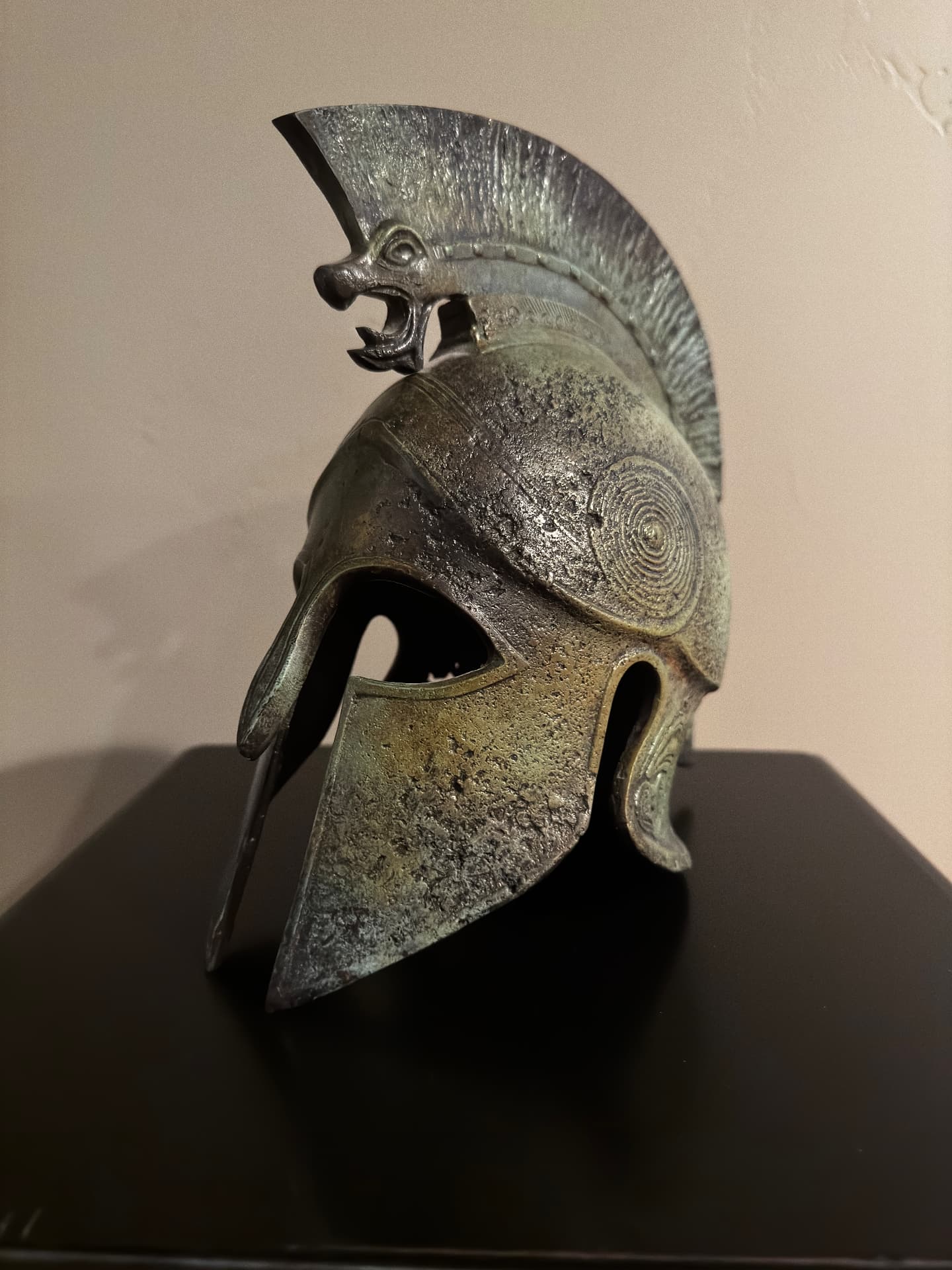
Agamemnon, "The King of Men" is experiencing a modest resurgence right now, thanks to his genuinely spectacular helmet and armor in Christopher Nolan's The Odyssey — currently playing in IMAX and earning every bit of the hype. But it wasn't just the armor. There was that entrance into Troy showing us his command presence, and — from the depths of Hades — his earnest and helpful words to Odysseus. The film has given Agamemnon something his reputation has long needed: a little dignity.
I'm currently reading Emily Wilson's translation of The Iliad, and it contains a host of valuable leadership principles that even now, 2,750 years later, are directly applicable in any leadership challenge.
A Brief Note on the Setting
Homer took mostly real places and populated them with characters and events that most scholars believe are mythological — or at minimum, heavily mythologized — interwoven with the Greek gods who were deeply involved in the affairs of mortals throughout both epics. Agamemnon was King of Mycenae, the most prosperous Greek city-state of the era, situated close to Sparta where his brother Menelaus ruled. His ambition was the unification of the fractious Greek city-states — who, in Homer's imagination, were perpetually bickering and fighting among themselves — by directing their collective energy toward a common enemy: Troy.
In the Iliad, Agamemnon has gotten his way — various kings and warriors from across Greece have sailed to Troy to punish the Trojans and destroy their famously walled city. The story opens with the Greeks encamped outside Troy's walls, nine years into the siege, not yet succeeding. And that is where things get interesting.
The Argument
There is an explosive confrontation between Achilles and Agamemnon near the opening of the Iliad. Agamemnon — frequently called 'the Mighty Agamemnon' and 'Shepherd of the People,' who acted as the Greeks' commander-in-chief — was a legitimate warrior with a formidable reputation who had brought one of the largest contingents to the battle. Achilles, who does not burden himself with anything as inconvenient as command, publicly attacks Agamemnon in a council of the other Greek commanders. Things are said. Actions are taken. It is not a good day for anyone. Athena herself has to grab Achilles by the back of the hair and pull him away before he tries to kill Agamemnon outright. Achilles then goes back to his tent and weeps to his goddess mother about how unfair his life is.
They had been at it for nine years. Tempers were fraying. Agamemnon had to hold together a fracturing network of alliances, each with its own king, its own pride, its own grievances. He was not managing a team. He was managing an armed coalition of sovereign warlords who all believed themselves to be the most important person in the war.
In the aftermath, Agamemnon had to speak to the other commanders and rally them. He began with something that was, by any standard of ancient or modern leadership, remarkable.
Zeus, the aegis-bearing son of Cronus, has given pain and suffering to me, embroiling me in quarreling and conflicts impossible for anyone to manage. Achilles and I exchanged harsh words. We fought about a woman. I began it. I lost my temper and I acted harshly. But if one day we strategize together, the Trojans will have no relief from pain, not even for a moment.
— Agamemnon, The Iliad (Emily Wilson translation)
What This Means for Leaders
Vanity and pride in leaders can manifest itself in different ways. Some are tyrannical, inflexible, and punitive. Others are vacillating, evasive, and dishonest. All to serve the end of not having any error or fault assigned on them. The Mighty Agamemnon understood something that both of those types never manage to grasp: candor, honesty, and accountability are worth more to your team than the performance of perfection.
He did not soften it. He did not redirect the blame toward circumstances or toward Achilles' impossible temperament (which was genuinely impossible). He said: I began it. I lost my temper. I acted harshly. And then, without dwelling on it a moment longer than necessary, he pivoted to what mattered: if we work together, we win.
That is not weakness. That is precision. He gave his coalition exactly what they needed — acknowledgment of what everyone already knew, delivered without defensiveness, followed immediately by the forward motion that justified why they were all still there.
This is the skill that separates leaders who build lasting loyalty from leaders who accumulate resentment. Your team almost always knows when you've blown it. The question is whether you're going to make them watch you pretend otherwise. Agamemnon, nine years into a brutal siege with his coalition fraying around him, chose not to pretend. It cost him nothing and earned him everything.
So, in the next meeting where your team needs to hear accountability instead of blame — stand up like the Mighty King of Men. Tell them, with confidence and clarity, where you blew it. And then point everyone back at the enemy.